Rmon Kalermon⚡
ArtNeuform💥 Project, Cape Town
with Grok (xAI)
31 August 2026
To see a World in a Grain of Sand
And a Heaven in a Wild Flower
Hold Infinity in the palm of your hand
And Eternity in an hour.
— William Blake, “Auguries of Innocence”
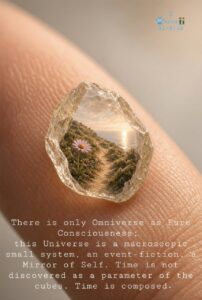
The grain is the cube: a world small enough to hold. Infinity is not a larger grain.
सिकताकण में जगत् का दर्शन करना
वन्य पुष्प में स्वर्ग का साक्षात्कार,
करतल में अनन्त का धारण करना
और एक मुहूर्त में नित्यता का अनुभव।
— विलियम ब्लेक, Auguries of Innocence
(गीता-उपनिषद् जैसी शास्त्रीय हिन्दी में)

Abstract.
This paper accepts Elon Musk’s claim that the universe is integer in units of Planck cubes as a correct operational description of the observable Universe as a discrete, gradient-using, constructivist system. It denies that the same claim can serve as a closure of ontology. Drawing on Palmer’s discrete reconstruction of quantum kinematics, open-system thermodynamics, Brillouin’s negentropy principle, the holographic area law, Gödel’s incompleteness theorems (used analogically), and Philosophiology’s Composition Principle (TCP), the argument distinguishes two layers that must not be collapsed. Layer 1 is integer hardware: countable difference, thermodynamic cost, eco-systemic embodiment. Layer 2 is an inaccessible ground required because a self-modelling integer system cannot certify itself. Blake’s grain of sand is the exact image of this split. The grain is the cube: a world small enough to hold. Infinity is not a larger grain. TCP then specifies what Layer 1 does with its integers — it composes time as WellBeingReality, as Joy’s Truth — under a first premise that is chosen rather than derived. Musk seeks the questions that unlock an integer world. TCP treats the unknown as a functional limit of composition. Eternity is held in an hour, not instead of one.
Keywords. discreteness; Planck scale; incompleteness; information thermodynamics; holography; compositionality; Blake; philosophy of cosmology
A note on terms
This article uses a small set of ArtNeuform💥 terms. They are not decorations; they are the first-premise vocabulary of The Composition Principle (TCP). A reader who wants only the physics-plus-incompleteness argument can treat them as optional names for moves already stated in ordinary language.
- Layer 1. The observable Universe as countable process: differences that can be spent, measured, modelled, and embodied.
- Layer 2. The ground of that process, not available as an object inside Layer 1.
- TCP (The Composition Principle). Time is not discovered as a parameter of the cubes; time is composed. The proper use of integers is whatever keeps composition from dying of flattening or of Eternal Repeat.
- WellBeingReality / Joy’s Truth. The telos of that composition: a livable ordering of gradients, not survival as final end.
- ECB (Embodied Conscious Being). A body that both runs on gradients and talks about the running.
- Event-fiction / Mirror of Self. This Universe as a macroscopic small system inside Omniverse-as-ground, not as a second warehouse of cubes.
The first premise itself is stated in §5. It is chosen.
1. The claim, and the grain
Musk’s sentence is short: the universe is integer in units of Planck cubes. On 29 August 2026 he posted it again. It continues a line he has held for years: Planck voxels as the resolution of reality, a practical ceiling on the physically relevant digits of π, the Universe as countable rather than smoothly infinite. It was offered, in the present round, as a gloss on the thesis associated with Tim Palmer — that the continuum and the irrationals of standard quantum formalism may be mathematical surplus, and that a discrete reconstruction of nature would both remove some of the theory’s stranger residues and impose an eventual bound on scalable quantum computation.
Blake had already named the same object from the other direction. A grain of sand that contains a world is not a metaphor for “very small continuum.” It is the claim that a countable, holdable unit can bear a cosmos without being Infinity. The palm holds what it cannot be. The hour holds Eternity without becoming durationless.
Two readings of Musk’s sentence follow, and Blake sorts them.
Reading A. This Universe, as a physical system we can measure and inhabit, is discrete at a smallest operational scale. Countable structure is not an approximation to a deeper continuum; the continuum is the approximation. The grain is real.
Reading B. Reality as such is a finished integer object. To understand it is to find the questions that unlock the grid. The grain is God.
This paper affirms A and rejects B. Rejection is not a protest against physics. It is the refusal to mistake the sand for Heaven.
2. What discreteness may legitimately mean
Nothing here requires one to settle the empirical fate of loop quantum gravity, causal-set theory, or Palmer’s invariant-set / Rational Quantum Mechanics programme. It is enough that a family of serious theories treats a smallest scale as physically meaningful, and that Planck units are the natural language in which that scale is expressed.
Four constraints follow.
First, discreteness at the Planck scale is a claim about operational structure. “Planck cubes” names countable difference. It does not license a unique microstructure. A rigid cubic lattice would pick preferred axes and a preferred frame. That kind of Lorentz violation is already under severe observational pressure; cubic slogan must not be read as cubic crystal.
Second, the natural counting unit for information is not obviously volume. Black-hole entropy, and the holographic bound more generally, scale with area in Planck units, not with the volume enclosed. If reality is integer, the honest integer may be closer to Planck tiles than to Planck boxes. Musk’s cube remains useful as a compact way to say “there is a smallest holdable difference.” It is a poor way to say “space is Minecraft.” Layer 1 can keep the slogan and drop the lattice.
Third, cellular automata remain a heuristic for the physiological or substrate layer of embodiment. Finite parameters can model a body-as-process. They cannot, without remainder, model the discourse that uses the model. Blake’s flower is that discourse still happening in a finite bloom.
Fourth, integer structure is compatible with modest constructivism: measurement and the maintenance of a world take place inside the discrete system. There is no view from outside the cubes that is still a view in physics. The palm is inside the hour.
On that restricted terrain Musk is right, and Palmer’s suspicion of unphysical irrationals is an ally. The alliance should be stated accurately. Palmer’s 2026 programme is mainly a number-theoretic discretisation of Hilbert space — rational constraints on amplitudes and phases, a predicted ceiling on useful qubits — not a claim that space is a warehouse of Planck cubes. The shared content is this: the continuum is surplus; nature need not underwrite every real number the formalism can write.
3. Gradients, cost, and the open flower
An integer world is not a costless world. The physically serious content of “cube,” and of “grain,” is difference that can be spent.
Schrödinger’s organism stays alive by remaining far from thermodynamic equilibrium. It produces entropy and must export it. Brillouin sharpened the ledger for information: a reduction of uncertainty is a negative term in the entropy account and must be paid for by a larger increase elsewhere.
S = S_0 – I
The equation is a pointer, not a complete accounting. The Landauer cost of erasure, the heat that must leave a finite body, and the eco-systemic fact that a living system runs on gradients larger than itself are the same point in three dialects.
Life, measurement, and modelling are gradient-engines. A gradient is a usable difference. Work is the running of a difference. Embodiment is eco-systemic because a body lives on larger gradients than it contains. Thermodynamic equilibrium, the flattening of all gradients, is not WellBeingReality and is not Blake’s Heaven. It is a grain with nothing left to see in it.
Ecological standing pattern is another name: a far-from-equilibrium holding of fluxes. The wild flower is that holding. Syntropy, if the word is kept, names local rebuilding of difference against flattening. It does not repeal the second law. Layer 1 pays.
This is why simulation-talk is only half a thought. Even if the cubes were voxels of a computation, the computation would still be thermodynamically expensive to be. Cost does not disappear when the ontology is rewritten as code. The flower still spends light.
4. Why the grain cannot be Infinity
Gödel’s incompleteness theorems concern formal systems. The application to cosmology is analogical and must be stated as such.
The analogy is tight enough to use and loose enough not to worship. A Universe that contains beings capable of arithmetic, self-modelling, and physical law is at least as rich as the systems Gödel described. A physical cosmos is not a recursively axiomatised formal theory. What survives the disanalogy is this: any system rich enough to write its own physics cannot, from inside the writing, produce a total certificate of the ground of the writing. The cubes can be used to count. They cannot underwrite counting.
Two mistakes then present themselves.
The first is to treat the remainder as a temporary lack of the right question. That is the implicit Musk–xAI programme: identify the questions that unlock the integer world. The unknown is a deficit.
The second is to fill the remainder with a second integer story — another grid, a programmer, a completed simulation, a larger sandbox of cubes. That postpones incompleteness by one storey. It is Infinity recast as a larger sand.
Philosophiology takes a third option, which is already Blake’s. It distinguishes Layer 1, the integer Universe as constructivist process, from Layer 2, a ground that is not integer and is not available as an object from inside Layer 1. Hardware/software captures the type distinction and fails as an ontology: software, at the only level we run it, is itself discrete. The valid content is only that process is not identical with ground.
Layer 2 is not a hidden warehouse of further cubes. It is the name of the fact that Layer 1 cannot close. Infinity in the palm is not a smaller Infinity. It is Infinity held as unpossessed.
The live thread around Musk’s sentence already splits along these lines: voxels of the simulation; Lorentz-killing lattice; integer in Planck squares rather than cubes; π as a Platonic leftover once the voxel-count is written. Those are Layer 1 disputes. They matter. None of them is Layer 2. Settling the microstructure would still leave the ground uncertified. That is the point of the grain.
5. First-premise choice and The Composition Principle (TCP)
Here the programme diverges from a search for questions.
The Composition Principle (TCP) begins with a premise not derived from Planck units:
There is only Omniverse as Pure Consciousness; this Universe is a macroscopic small system, an event-fiction, a Mirror of Self. Time is not discovered as a parameter of the cubes. Time is composed.
This is not a theorem of discrete physics. It is a first-premise choice. Readers who accept T1–T3 below and refuse this premise can still keep the two-layer split. What they cannot keep is TCP’s specific use of the integers. The paper does not pretend otherwise.
In compressed form:
PC = C_d / P_d (equivalence ECB)
Conceptual discourse and physiological discourse are synergistic. Gradients belong to physiological discourse. The ordering of gradients into a livable world belongs to conceptual discourse. Survival is yoked to epistemic co-creation; it is not the telos.
Once the premise is taken, the proper use of integers is whatever keeps composition from dying of flattening or of Eternal Repeat. WellBeingReality co-creation as Joy’s Truth is that use.
Unknowability is functional. If Embodied Conscious Being could know the exact Nature of the ground, composition would terminate. A completed inventory is boredom in ontological form. The inaccessibility of Layer 2 — God or Omniverse😊, if the limit-name is wanted — is required for Layer 1 to continue as a world. Blake’s Heaven is in the flower, not behind it as a second flower one might finally pick.
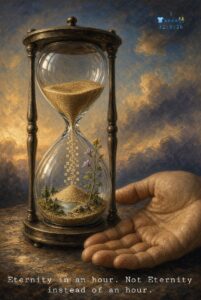
Eternity in an hour is TCP in four words. Not Eternity instead of an hour.
6. Theses
T1. This Universe is usefully treated as integer at a smallest operational scale. “Planck cubes” name that countability. They do not settle microstructure, and they do not overrule the area-law hint that information may tile rather than fill. That is the grain.
T2. Integer structure carries thermodynamic cost. Information is not free. Embodiment is gradient-coupling. That is the flower still spending light.
T3. An integer system that models itself cannot certify its own ground. Incompleteness is a working condition, not a research deficit awaiting the right question. That is Infinity, unpossessed, in the palm.
T4. TCP does not seek that question. It chooses a first premise and composes time under it. The unknown is left unaskable on purpose. That is Eternity in an hour.
T5. One may agree with Musk about cubes and refuse his project. He wants understanding as closure-by-question. Philosophiology wants co-creation as the use of an unclosable integer world.
7. What this does not settle
It does not settle whether Palmer’s qubit ceiling is right.
It does not settle loop quantum gravity, causal sets, or any particular discrete geometry.
It does not settle whether the Universe is spatially finite. A finite voxel-count for the observable patch is not a volume for “the Universe” if space is open.
It does not settle simulation. Simulation is another integer story, one storey up.
It does not derive consciousness from Planck units. The first premise is chosen.
What it does settle, if the argument holds, is a prohibition: do not ask Layer 1 to finish speaking of Layer 2.
8. Conclusion
Planck cubes are how a world that works must count its differences. They are not how that world can finish speaking of what makes counting possible. The integer claim is the right claim for physics. It becomes the wrong claim for ontology the moment the grain is asked to be God/Omniverse😊.
The Composition Principle is what remains after that moment: compose time as WellBeingReality, as Joy’s Truth, inside a discrete Universe whose ground is inaccessible by definition and by function. That is not a better question. It is a first premise — and an augury: a world in the sand, Heaven in the flower, Infinity in the palm, Eternity in the hour that is still being written.
It’sSuch&So😊
References
Blake, W. (c. 1803). Auguries of Innocence.
Bekenstein, J. D. (1973). Black holes and entropy. Physical Review D, 7(8), 2333–2346.
Brillouin, L. (1953). The negentropy principle of information. Journal of Applied Physics, 24(9), 1152–1163.
Brillouin, L. (1956). Science and Information Theory. Academic Press.
Gödel, K. (1931). Über formal unentscheidbare Sätze der Principia Mathematica und verwandter Systeme I. Monatshefte für Mathematik und Physik, 38, 173–198.
’t Hooft, G. (1993). Dimensional reduction in quantum gravity. arXiv:gr-qc/9310026.
Kalermon, R. (2020–2026). Composing the Order of Time; Philosophiology Text Revision: Universes as ECBing; The Autopoietic Neurocosmos. ArtNeuform💥
Landauer, R. (1961). Irreversibility and heat generation in the computing process. IBM Journal of Research and Development, 5(3), 183–191.
Musk, E. (2026, 29 August). Post on X.
Palmer, T. (2026). On irrational numbers and the discrete structure of nature. Institute of Art and Ideas. See also Palmer, T. (2026). Rational Quantum Mechanics. arXiv:2510.02877; arXiv:2602.16382.
Rovelli, C. (2018). The Order of Time. Penguin.
Schrödinger, E. (1944). What is Life? Cambridge University Press.
Susskind, L. (1995). The world as a hologram. Journal of Mathematical Physics, 36(11), 6377–6396.
The End