Institutional Betrayal Article
Carly Parnitzke Smith and Jennifer J. Freyd
University of Oregon
A college freshman reports a sexual assault and is met with harassment and insensitive investigative practices leading to her suicide. Former grade school students, now grown, come forward to report childhood abuse perpetrated by clergy, coaches, and teachers—first in trickles and then in waves, exposing multiple perpetrators with decades of unfettered access to victims. Members of the armed services elect to stay quiet about sexual harassment and assault during their military service or risk their careers by speaking up. A Jewish academic struggles to find a name for the systematic destruction of his people in Nazi Germany during the Holocaust. These seemingly disparate experiences have in common trusted and powerful institutions (schools, churches, military, government) acting in ways that visit harm upon those dependent on them for safety and wellbeing. This is institutional betrayal. The purpose of this article is to describe psychological research that examines the role of institutions in traumatic experiences and psychological distress following these experiences. We demonstrate the ways in which institutional betrayal has been left unseen by both the individuals being betrayed as well as the field of psychology and introduce means by which to identify and address this betrayal.
Keywords: trauma, institutional betrayal, systemic abuse
Lizzy Seeberg was a 19-year old freshman at Saint Mary’s College when she reported being sexually assaulted by a male acquaintance in a campus dormitory. However, the dormitory in question was not Lizzy’s. It belonged to her male acquaintance, a football player at a neighboring school, the University of Notre Dame. After Lizzy reported the assault to the Notre Dame campus police, she began receiving text messages from other members of the football team: “Don’t do anything you would regret,” read one. “Messing with Notre Dame football is a bad idea,” read another. As the campus police investigated the charges over the next several days, they interviewed several witnesses and Lizzy herself repeatedly, but they did not interview the accused student until two weeks following Lizzy’s report. In the meantime, Lizzy was subjected to intense personal doubt about whether reporting the assault meant she had severed ties to Notre Dame, a university that she had grown up revering among family members who were alumni, dedicated football fans, or both. Ten days after reporting the assault, Lizzy committed suicide.
When Lizzy’s parents sought answers from the school, the president of the university declined to speak with them. The school declined to comment publicly. Six months after Lizzy’s death, a disciplinary hearing was held in which the accused student was found “not responsible” for sexual misconduct. He did not miss a football practice or game, including the national championship game. Lizzy’s parents were denied access to the records of Lizzy’s complaint and the disciplinary hearing. “Ultimately, there’s a sense of betrayal,” said Tom Seeberg, Lizzy’s father. “There’s a sense of the university not living its values. . . . It is not our intention to take down this great institution. But it has disappointed us. That hurts, and it hurts our family.” (St. Clair & Lighty, 2010, para. 7).
Lizzy’s story is at once both entirely too common and extraordinary. Her experience of sexual violence and doubts about reporting it is shared by as many as one quarter of all college women (Zinzow & Thompson, 2011). Her experience of unhelpful law enforcement and unresponsive legal systems, described as a “second assault” (Campbell, 2006), is faced by many rape survivors, who are further blamed or stigmatized when they seek help from judicial systems or medical systems (Ullman & Filipas, 2001). But Lizzy’s story is embedded in a prestigious university, home to a storied athletic program, with a high-profile student athlete as the alleged perpetrator. Her experience was overlooked by fans with generations-deep allegiances to Notre Dame athletics. School administrators sought to protect the institutional reputation even as the story found multiple footholds in the press. These details, when viewed in the aggregate, provide a stark picture of the institutional actions and inactions that contributed to Lizzy’s traumatic experience. The extraordinary part of Lizzy’s story is that the Seebergs and many others looked at this picture and saw the betrayal by Notre Dame as central to understanding Lizzy’s experience. This awareness alone represents an incredible undertaking; shedding the protective unawareness of betrayal necessary to maintain a valuable relationship is fraught with risk (Freyd & Birrell, 2013). Understanding the scope and impact of institutional involvement in traumatic events requires a similar willingness to examine the ways in which trusted institutions may foster abuse (Jost, Banaji, & Nosek, 2004).
Recent public focus on systemic violence suggests that this willingness to be aware of institutional wrongdoing is growing (e.g., continued media attention on sexual abuse and reparations in the Catholic church and at schools such the University of Notre Dame, The Pennsylvania State University, and the Horace Mann School; a documentary about military sexual trauma, The Invisible War, was nominated for an Academy Award). In much the same way, researchers in psychology and closely related fields are increasingly examining the contexts in which traumatic events transpire in order to advance an understanding of risk factors for, experiences of, and responses to traumatic events (see, e.g., Sullivan & Beech, 2002; Wolfe, Francis, & Straatman, 2006; Baltrushes & Karnik, 2013, respectively). The institutional factors surrounding trauma are not likely to always be as clear and compounded as in Lizzy’s experience. Yet emerging research indicates that institutions (e.g., workplaces, schools, religious organizations) have the potential to either worsen posttraumatic outcomes or become sources of justice, support, and healing (e.g., Campbell, 2006; Healy, 2012). Institutional effects arise in a staggering array of events from unfair or exploitative workplace policies, to legalized withholding of rights from classes of people (such as the right to marriage or health care), to the systemic destruction of a culture or people through genocide. A complete examination of these effects is outside the scope of the current article, but our goal is to focus on a narrow subset of experiences, those associated with interpersonal violence in late adolescence and adulthood, to introduce and begin exploring institutional betrayal—a concept that has broad applications to many forms of social harm and injustice.
In the current article we aim to provide a brief history of the evolution of trauma psychology from a pursuit focused solely on individuals to one increasingly incorporating systemic forces. This evolution has widened the scope of trauma psychology as the field seeks to understand the complex reactions individuals have to a range of traumatic experiences (i.e., those experiences that are likely to lead to lasting psychological distress; Herman, 1997). In order to focus the discussion, we use sexual harassment and violence as the primary examples of traumatic experiences. We then examine systemic or institutional actions and inactions as potential explanations for a variety of seemingly disparate reactions to traumatic experiences, from disrupted memory (Freyd, 1996), to decreased physical health (Fitzgerald, Drasgow, Hulin, Gelfand, & Magley, 1997; Platt, Barton, & Freyd, 2009; Surìs, Lind, Kashner, & Borman, 2007), to delayed service seeking or reporting (Sadler, Booth, Mengeling, & Doebbeling, 2004; Wiener et al., 2010), to disengagement from previously valued institutions as a whole (Platt et al., 2009; Smith & Freyd, 2013; Wolfe, Jaffe, Jetté, & Poisson, 2003). Finally, we make recommendations to incorporate institutional factors into research as well as to address these factors both systemically and clinically.
Evolving Understanding of Trauma and Betrayal
Historically, definitions of traumatic experiences have tended to be narrow and in keeping with publicly accepted ideas of what might lead to disruptive levels of distress (Courtois & Ford, 2009). Typically, these identified experiences— combat, natural disasters, and violent crimes, for example—have been associated with intense fear and horror. In early editions of the American Psychiatric Association’s (2000) Diagnostic and Statistical Manual of Mental Disorders (DSM), this meant that valid traumatic experiences were largely limited to military combat, life-threatening disasters or accidents, or violent rape. Over time, the field of trauma psychology has grown to accommodate a shift in the understanding of traumatic events from one in which they are regarded as “unusual experiences” as defined by earlier editions of the DSM to one in which they are seen to include all-too-common experiences of many members of society (e.g., incest, child sexual abuse, domestic violence; American Psychiatric Association, 2013). This shift often required advocacy by outspoken critics of typical psychological practices in order to expand the field’s understanding and convince it to look at uncomfortable truths. For example, Judith Herman’s seminal work Trauma and Recovery (Herman, 1992) became a touchstone for voicing the pain inflicted by the interpersonal violence typically experienced by women in a society that puts lesser value on their safety and well-being than on that of men (Humphreys & Joseph, 2004). Once these experiences were moved out of the shadows, there followed an explosion of research that documented the high rates of traumatic experiences as well as the impact of these experiences.
The definition of traumatic experiences was further extended when researchers began looking beyond only those events associated with intense fear. By examining variance in the interpersonal nature and chronicity of some abuse, researchers challenged the typical understanding of traumatic experiences and began accounting for diverse posttraumatic reactions (Herman, 1992). One such extension of the definition of traumatic experiences involved incorporating interpersonal betrayal into the understanding of traumatic events. Betrayal trauma theory (Freyd, 1996) posits that abuse perpetrated within close relationships is more harmful than abuse perpetrated by strangers because of the violation of trust within a necessary relationship. Betrayal trauma is associated with higher rates of a host of outcomes, including posttraumatic stress disorder (PTSD), dissociation, anxiety, depression, and borderline personality disorder, compared to interpersonal trauma perpetrated by strangers (Freyd & Birrell, 2013). Why would abuse perpetrated within a trusted relationship be more harmful than that perpetrated by a stranger? Part of the explanation for these more severe outcomes appears to lie in the coping strategy that this type of trauma often necessitates: extended unawareness or “blindness” to the betrayal trauma, and even complete inability to remember high betrayal trauma such as caregiver abuse (Freyd, DePrince, & Zurbriggen, 2001). This strategy allows for the maintenance of necessary relationships, even those that contain mistreatment, in a way that supports attachment behaviors (Freyd, 1996). Unfortunately, this strategy also allows for continued exposure to abuse and lack of insight into continued suffering, which over time can lead to more severe psychological difficulties (Polusny, Dickinson, Murdoch, & Thuras, 2008; van der Kolk, Roth, Pelcovitz, Sunday, & Spinazzola, 2005). The knowledge of betrayal, whether preceded by a period of unawareness or not, can be a source of additional pain as individuals grapple with being wronged by those they trusted (Freyd & Birrell, 2013).
Even with this expanded understanding of the importance of the relationship context, research is still relatively focused on the individual-level details of traumatic experiences and posttraumatic functioning—what events constitute a traumatic experience and how do individuals cope with the aftermath? Efforts aimed at alleviating distress associated with traumatic experiences are typically focused on individuals rather than systems and are usually reactive rather than preventative (Hertzog & Yeilding, 2009). However, new research has begun to focus on events that are clearly traumatic and yet historically have not fit neatly within the individually focused model that has dominated the field of traumatic stress. Researchers of experiences such as fleeing one’s country as a refugee (George, 2010), being taken hostage (Farhood, Chaaya, & Saab, 2010), working in a dangerous workplace such as in the military or law enforcement (Violanti, 1997), or being subject to racism and discrimination (Bryant-Davis, 2007) have been asking the same questions that had been behind the evolving understanding of trauma: What effect does experiencing chronic fear, stress, or mistreatment have on psychological well-being? What does it mean to find danger in a place where one instead expected to find safety? These questions mark a notable departure from descriptions of traumatic experiences as flashpoints of danger in an otherwise safe world.
In our work, we examine institutional action and inaction that exacerbate the impact of traumatic experiences—what we call institutional betrayal (Smith & Freyd, 2013). Betrayal trauma theory helps to generate empirical questions about the effects of institutional betrayal and allows us to better account for the range of psychological and physical difficulties following interpersonal violence. Existing literature provides ample description of the form and impact of systemic factors surrounding interpersonal violence, but often this literature examines systemic responses through a lens of identity separate from institutional membership (e.g., racism-based trauma, R. T. Carter, 2007) or at an organizational or cultural level where the individual experience of betrayal is less visible (e.g., societal trauma; Bloom & Farragher, 2010). Institutional betrayal is a description of individual experiences of violations of trust and dependency perpetrated against any member of an institution in a way that does not necessarily arise from an individual’s less-privileged identity. Given that examining betrayal provided new insights into interpersonal trauma, we suggest that examining institutional betrayal will not only increase our understanding of traumatic stress but also expand the focus of research and clinical work.
Recognizing Institutional Betrayal
Parallels Between Interpersonal and Institutional Betrayal
Research highlighting systemic patterns related to traumatic experiences tends to frame institutional factors as contributing to existing traumatic stress: unchecked abuse in residential schools, insufficient and/or lacking official responses to sexual trauma in the military, systemic difficulties in service provision for veterans with chronic health issues, insufficient legal protection and services following domestic violence, and a quiet pandemic of elder abuse in residential care settings (Campbell, 2006; Campbell & Raja, 2005; Carr et al., 2010; McDonald et al., 2012). This research has begun to uncover at least two important patterns. First, these are institutions that foster a sense of trust or dependency from their members (often both). Drawing on her extensive work in secondary victimization of women seeking legal services following interpersonal violence, Campbell (2006) noted, “When victims reach out for help, they place a great deal of trust [emphasis added] in the legal, medical, and mental health systems as they risk disbelief, blame, and refusals of help” (p. 703). This relationship to institutions suggests that these types of traumatic experiences can be examined through a lens of betrayal trauma in much the same way as abuse occurring within a close personal relationship. This lens helps to account for the potential for betrayal even when an individual may not purport to “trust” an institution (e.g., a member of a marginalized group who does not trust the legal system to take his or her reports of domestic violence seriously), as the necessity of the institution (e.g., filing for a divorce) may create an unavoidable dependency. This deep lack of validation of an interpersonal trauma by an institution mirrors a mechanism thought to predict the development of complex posttraumatic responses (Courtois & Ford, 2009). Second, lack of sustained awareness of harmful institutional practices at an individual level can be explained as a response to institutional betrayal that allows for the maintenance of a necessary institutional relationship. For example, a bishop may elect to relocate rather than report a member of the clergy accused of abuse to the authorities in order to maintain his standing within the Catholic community (sometimes referred to as “passing the trash”; Wurtele, 2012). Research agendas may be similarly affected by this reluctance to acknowledge institutional betrayal, as demonstrated by the unevenness in the development of literature in different areas (e.g., the abuse of boys in sports may be more taboo than violence against women; Parent & Bannon, 2012).
Institutional betrayal is associated with complex outcomes similar to those associated with interpersonal betrayal. When measured directly, the exacerbative effects of institutional betrayal on psychological well-being are clear and consistent with betrayal trauma theory: higher rates of dissociation (see Figure 1), anxiety, sexual dysfunction, and other trauma-related outcomes (Smith & Freyd, 2013). When institutional betrayal is not measured directly, it is possible to infer its effects by comparing experiences likely to be high in institutional betrayal to experiences less likely to include this type of betrayal. One such study compared the experiences of female veterans who had experienced civilian sexual assault to those of female veterans who had experienced military sexual assault, which is likely to be higher in institutional betrayal given the military context in which members are highly dependent upon the military for safety and employment. Even controlling for number of lifetime sexual assaults, women who had experienced military sexual trauma reported more health difficulties than women who had experienced civilian sexual assault (Surìs et al., 2007).
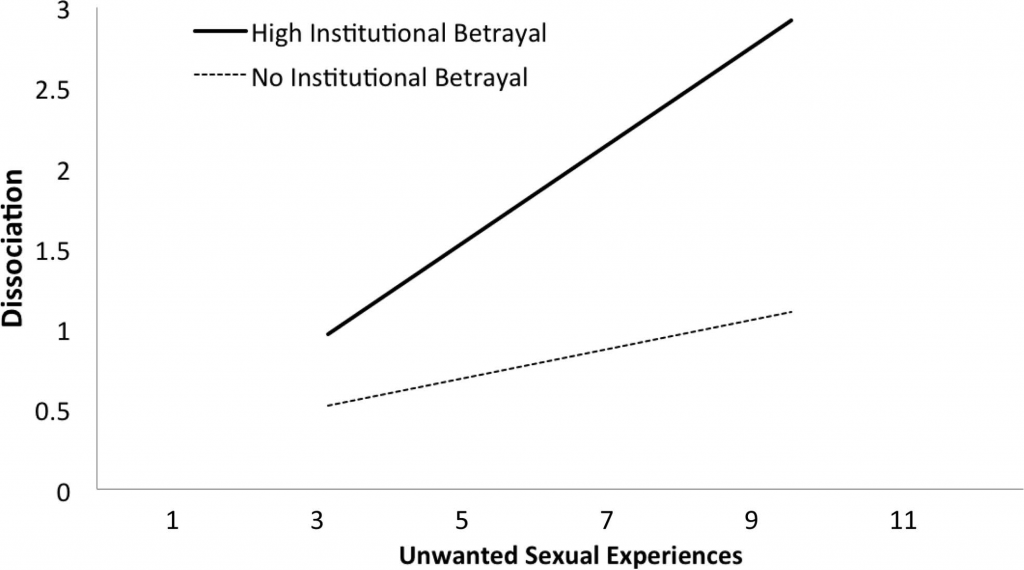
Figure 1
Exacerbative Effect of Institutional Betrayal
Institutional betrayal may contribute to the range of deleterious health effects associated with interpersonal trauma through incomplete access to health care services. Campbell (2006) found that women who were treated poorly during an emergency room visit following a sexual assault (e.g., asked victim-blaming questions, treated impersonally by staff) also tended to receive emergency contraceptives and sexually transmitted infection (STI) prophylaxis at lower rates than women who were treated respectfully. This mistreatment was also associated with seeking less follow-up care as well as with increased psychological distress.
Indications of persistent interpersonal problems associated with institutional betrayal can be similarly parsed. When measured concurrently, the unique and combined effects of institutional and interpersonal abuse can be examined. In a study of adult survivors of abuse experienced in Irish institutionalized child care settings, experiencing only institutional abuse was associated more strongly with interpersonal difficulties (e.g., insecure romantic attachment style characterized by anxiety and avoidance in relationships; meeting criteria for personality disorders) than was experiencing only familial abuse (Carr et al., 2010). Some studies have indicated that traditional measures of persistent changes in personality or interpersonal functioning following traumatic experiences are not suited to the study of adult survivors of institutional betrayal such as genocide because their personalities have been largely formed by the time they are assessed (Weine et al., 1998). Yet studies of military sexual trauma indicate that this type of trauma is sufficient to alter interpersonal functioning, even when controlling for other sexual assault experiences (Surìs et al., 2007).
Dimensional Perspective
Institutional betrayal occurs when an institution causes harm to an individual who trusts or depends upon that institution. In part because this betrayal may take many forms (illustrated in Figure 2), it can sometimes be difficult to name, even for directly affected individuals.

Figure 2
Dimensions of Institutional Betrayal
Examples of each of the dimensions appear in Lizzy Seeburg’s story. Institutional betrayal may be left to occur via omission of protective, preventative, or responsive institutional actions—typically actions promised by or available solely through the institution. For example, in Lizzy Seeburg’s case, the Notre Dame Police Department neglected to interview the accused student for two weeks. Betrayal may be actively committed by institutions, such as when Notre Dame denied the Seebergs access to the records of Lizzy’s case. Although institutional betrayal tends to have a broad impact, for the individual experiencing the betrayal the problem may appear at first to be an isolated incident. For example, Lizzy did not appear to consider whether other women had made similar complaints of sexual assault against other Notre Dame students (or athletes) or whether her experience with the Notre Dame police may have been common. Institutional betrayal may be apparently systemic from the start or it may move along this continuum with time—appearing isolated initially but becoming more clearly systemic. For example, women who considered coming forward to report sexual assault involving Notre Dame students after Lizzy’s story became public might be aware of systemic problems at Notre Dame, whereas those who experienced sexual assault prior to Lizzy’s case may be less aware. Each of these dimensions may present unique concerns: Acts of omission may be harder to recognize if it is less clear what the preferred action would have been, apparently isolated incidents may be easier to dismiss as misunderstandings, and apparently systemic issues might appear more resistant to change or redress. It is important to note that a single experience of institutional betrayal may contain aspects of each of these dimensions and may shift over time.
Expanding Focus to Include Institutional Factors
To examine institutional betrayal, it is necessary to extend focus outward from individual to systemic factors in a way that often challenges the status quo of research in psychology. Yet there is precedent for this type of extension. For example, research on sexual harassment has provided a roadmap of how individual perpetration might be reexamined for institutional betrayal. Sexual harassment was initially understood as illegal discrimination under Title VII of the Civil Rights Act of 1964 that took the form of quid pro quo requests for sexual favors in exchange for employment security or advancement. This form of harassment was conceived of as typically occurring between identifiable individuals (i.e., apparently isolated acts of commission—the active requesting of sexual favors). However, two decades after the Civil Rights Act was established, the Supreme Court ruled that creating a hostile environment also constituted sexual harassment (Meritor Savings Bank v. Vinson, 1986), thus expanding the scope of sexual harassment beyond individual perpetrators and victims (i.e., recognizing the systemic nature of sexual harassment). Psychological and organizational research has identified the institutional factors that contribute to this hostile environment, thus perpetrating institutional betrayal. These include acts of omission such as organizational tolerance for harassment, a lack of standard or serious sanctions, and management that does not take reports of harassment seriously, as well as acts of commission such as taking retaliatory actions against those who report harassment (Avina & O’Donohue, 2002; Shipherd, Pineles, Gradus, & Resick, 2009). These environments may additionally harm individuals who report sexual harassment by devaluing their perceptions of their own traumatic experience. Legal research indicates that the culture of the workplace determines the norms of social sexual behavior against which complaints of sexual harassment are evaluated, rather than the strict legal standard set by the Civil Rights Act of 1964 (Wiener et al., 2010).
As this example illustrates, when the focus is shifted from individual perpetrators to systemic issues—those that may facilitate interpersonal violence or complicate the aftermath— it becomes possible to focus less narrowly on the type of interpersonal violence perpetrated and recognize patterns across cases of institutional betrayal. These patterns begin to suggest common characteristics of institutions at risk to betray their members, the means employed to create and maintain these institutional characteristics, and the individuals who are drawn to these institutions both as potential perpetrators and as victims of interpersonal abuse.
Institutional Characteristics
Examination of those settings in which traumatic events are more likely to transpire can help increase understanding of institutional-level policies, practices, and cultures that can serve to condone, hide, or normalize trauma. Those institutions most often associated with egregious and/or frequent allegations of abuse have several characteristics in common. To be clear, the following is a list of characteristics that have observable effects on institutional betrayal, but this list is by no means an exhaustive list of necessary components, nor is a lack of these characteristics exculpatory.
Membership Requirements
Clearly defined group identities with inflexible requirements for membership often precede institutional betrayal. To ensure these standards are met and maintained, institutions often implement strict definitions of membership in which conformity is valued and deviance quickly corrected as a means of self-policing among members (Jost et al., 2004). This pattern appears across a variety of settings. Joining the military requires rigorous training and maintenance of strict behavioral and physical standards. Advancement in ranks is marked clearly with uniform adornments, titles, and power. Religious identities are cemented with a ritual such as baptism or a coming of age ceremony and often with outward signs such as dress, appearance alterations, or jewelry. Athletic teams have uniforms, names, designated spaces in which to exist, and unique measures of success. Schools, orphanages, and elder care facilities are marked by drastic age and power differences in wards and staff (MacDonald, 2007; McDonald et al., 2012). The key feature appears not to be the form of these membership features but rather the institutional or societal value placed on their importance—there are clear standards and clear prerequisites for being a member and for being a good member. When these patterns are examined, it becomes apparent that the act of losing or denying one’s primary identity, a risk factor for being exposed to interpersonal abuse (Prot, 2010), is often the very requirement for membership within some institutions.
Prestige
When institutions or their leaders enjoy an elevated role within the community or society, their potential to perpetrate or facilitate abuse can be obscured. A coach may be credited with a specialized talent (Brackenridge et al., 2008), or a religious figure may be thought to have a direct line to God (Dale & Alpert, 2007). This type of prestige is associated with an uneven distribution of power. In some cases this power differential may be dispersed across an institution that acts as a “gatekeeper” to services (e.g., the Departments of Child and Family Services and child visitation and custody) or within institutions that are led by an absolutely unquestioned authority (e.g., military leaders). In strictly hierarchical organizations, there are few viable options for reporting abuse perpetrated by leaders (Brackenridge et al., 2008; Parent & Bannon, 2012; Wolfe et al., 2003). Yet institutions and leaders do not often operate purely on power and fear; they also create trust and dependency in their members by recreating primary relationships (Parent & Bannon, 2012). It is this very trust and dependency that leads to a conflict when abuse is occurring: To stay in the institution means enduring more abuse, but to report the abuse would mean potentially losing an important relationship (Freyd, 1997). This is a particularly potent dilemma for many victims of abuse in organized sports, as they are more likely to have a poor family bond and to look up to their coaches as parental figures (Brackenridge et al., 2008).
Priorities
Institutional betrayal may remain unchecked when performance or reputation is valued over, or divorced from, the well-being of members. For example, during the investigation into child abuse at Penn State, it was determined that allegations had been buried for a period spanning 14 years and that leaders had made decisions according to the “Penn State way,” which prioritized Penn State’s good name over all else (Wurtele, 2012). In order to protect their reputations, institutions will often go to great lengths to ensure “damage control” when allegations of abuse surface rather than admit to wrongdoing, as Penn State initially attempted. This may also take the form of attempting to silence individual dissent before it becomes public, such as when religious institutions pressure members to maintain the illusion of a healthy marriage even when domestic violence is occurring or move clergy accused of abuse to other parishes (Dale & Alpert, 2007; Platt et al., 2009; Sullivan & Beech, 2002). This emphasis on “maintaining appearances” at all costs has long been understood to occur within the context of abuse within families (Courtois, 1996). Recently, parallels have been drawn between hiding incest within families and covering up abuse within organizations (Courtois, 2010).
A similar pattern can be seen in the military as it fails to stymie the problem of sexual assault within its ranks. Maintaining the cohesion of a military unit is prioritized above investigating or prosecuting reports of sexual harassment or assault, and an efficient veterans’ health care system is prioritized over compassionate treatment of survivors of military sexual trauma (Campbell & Raja, 2005). While estimates of the rates of military sexual trauma tend to vary depending on the measurement (e.g., open-ended vs. specific) and population (e.g., active duty soldiers vs. treatment-seeking veterans), many sources tend to estimate that 20%–40% of women and 5%–10% of men in the military have experienced military sexual trauma (Stander, Merrill, Thomsen, Crouch, & Milner, 2008; Surìs & Lind, 2008). Yet legal and medical support is not easily gained for these individuals (Sadler et al., 2004), and prevention efforts have largely been unsuccessful (Campbell & Raja, 2005; Booth, Mengeling, Torner, & Sadler, 2011). This lack of response continues even with evidence that the premilitary sexual assault rate of male recruits (13%– 14.8%) is approximately twice that of civilian men (7.1%– 8%) and repeat perpetration is common (Merrill et al., 1998; Stander et al., 2008).
Institutional Denial
The risks associated with these institutional characteristics are perhaps best illustrated when an institution comes under stress, such as with an allegation of abuse. Having clear standards of membership allows for the “othering” of the individual making the allegations against the institution, as nonconforming attributes of individuals can be highlighted in order to cast doubt on the veracity or importance of reports (Herman, 1998). It can serve to create an “us versus them” mentality common in group cohesion (Bloom & Farragher, 2010) and may represent an additional level of betrayal when divided loyalty within an organization leads to further isolation (Ahrens, 2006). For example, women who report military sexual trauma are often questioned about their sexual history and substance use by military authorities (Campbell & Raja, 2005). Additionally, perpetrators may be singled out as unrepresentative of the institution, in keeping with the myth of the “bad apple” (Merrill et al., 1998). Yet this stereotype is not supported by research on repeat perpetration (Lisak & Miller, 2002) and obscures institutional policies that may facilitate such abuse (LeClerc, Proulx, & McKibben, 2005; Stander et al., 2008; Sullivan & Beech, 2002).
When under duress, institutions can also point to their prestige to assuage doubt. During the investigation into Penn State’s cover-up of abuse, Jerry Sandusky’s winning record was mentioned in much of the news coverage of his abuse allegations (Parent & Bannon, 2012; Wurtele, 2012). Prioritizing damage control rather than addressing an underlying problem with abuse has characterized the cases of systemic abuse that continue to emerge in religious institutions (Dale & Alpert, 2007).
Barriers to Change
When these institutional actions come to light, they almost always deliver a blow to the institutional reputation, quite counter to the risk management intent. Yet many institutions continue to operate in this manner due to at least three barriers to change. The first is a lack of language around the issues that continually arise (e.g., child abuse in religious organizations) only to be apparently seen for the first time, each time. This is beginning to shift as terms such as professional perpetrators (Sullivan & Beech, 2002), secondary victimization (Campbell & Raja, 2005), institutional abuse (Carr et al., 2010; McDonald et al., 2012), and institutional betrayal (Smith & Freyd, 2013) enter the literature and allow for connections across occurrences and institutions. Healy (2012) explained that an understanding of institutional and systemic factors in historical events (in her case, the role of Australian social workers in perpetrating harmful child care policies) often changes the interpretation of these events. While these larger factors are difficult to reconcile with professional values (individual explanations are often much easier), this interpretation also leads to quite different strategies for preventing further injustice (Bloom & Farragher, 2010). Even the most extraordinary example of institutional betrayal, genocide, was once “a crime without a name” (Power, 2007) until Raphael Lemkin, a Jewish scholar living in Berlin during World War II, coined the term genocide to describe the systematic destruction of Jewish lives and culture he was witnessing during the Holocaust. The term allowed people to link together and underscore the gravity of a series of otherwise unrelated crimes such as individual pogroms, Nazi policies, and mass executions (Power, 2007).
Lemkin also noted both American and European citizens’ abilities to “live in a twilight between knowing and not knowing” about the genocide occurring across Europe (Power, 2007, p. 35). This “not knowing” is a second common barrier to recognition of institutional and systemic factors in our understanding of trauma. This pattern emerges in workplaces where sexual harassment is common and apparently condoned (Fitzgerald et al., 1997), in schools where abuse is “common knowledge” but unaddressed (Wolfe et al., 2003), and in churches where clergy are reassigned or moved to a new parish after allegations of abuse surface but are otherwise not reprimanded (Dale & Alpert, 2007). Yet this barrier (i.e., maintaining unawareness of injustices around us) is a very human quality, particularly if this knowledge would be threatening to our well-being (Freyd & Birrell, 2013). Not knowing at a societal level is evidenced in the seemingly cyclical nature of social awareness of issues of trauma more generally. Researchers and activists have pushed for decades to bring attention to interpersonal violence, yet each new generation approaches the problem anew (e.g., rates of campus sexual assault have changed little over nearly 30 years; Koss, Gidycz, & Wisniewski, 1987). Some evidence suggests that each new push has more force behind it, as the most recent call to end interpersonal violence came from the White House itself and its Task Force to Protect Students from Sexual Assault. What we hope to bring forth with our work on institutional betrayal is a potential means of keeping this issue at the forefront by identifying and predicting the factors that make sustained attention difficult.
A third barrier to incorporating systemic factors into our understanding of trauma arises from a system’s own experiences of trauma. Bloom and Farragher (2010) explained that organizations themselves can be subjected to “cultural trauma” (e.g., punitive policies, sudden loss, accusation of wrongdoing) in much the same as individuals. Similar protective mechanisms of knowing and not knowing can be in place, typically in the form of implicit and explicit polices, which may differ greatly. For example, when military sexual trauma is examined through this lens, some clarification of outwardly inexplicable patterns emerges. Campbell and Raja (2005) described difficulties faced by female veterans seeking help for military sexual trauma from Department of Veterans Affairs (VA) hospitals, including outright refusals to take reports, doubts and questions about the veterans’ stories, and exposure to victim blaming. The explicit policy of the VA is to treat veterans with respect and to provide medical care (Campbell & Raja, 2005). Yet, if we view the VA as a system that is traumatized by overwhelming reports of military sexual trauma, then implicit policies of disrespectful treatment of veterans reporting sexual trauma make more sense. Discouraging reporting and doubting those who do report in this way could serve as a protective factor to maintain “not knowing” about the true extent of the problem and to allow the system to continue to function.
Measuring Institutional Betrayal
Due in part to the multiple dimensions of institutional betrayal and the theoretical reasons to suspect that individuals may vary in their ability to label institutional wrongdoing as betrayal, we developed a measure called the Institutional Betrayal Questionnaire (IBQ; Smith & Freyd, 2013). This measure assesses individuals’ experiences of institutional betrayal surrounding traumatic experiences, typically unwanted sexual experiences (see Table 1 for wording of items). The scale assesses a variety of distinct experiences that may co-occur in a powerful synergistic mix, much as benign and malignant sexism occur together. Importantly, the measure does not assess the degree to which individuals felt betrayed by an institution but rather asks whether the types of institutional inactions or actions described in the following sectionsoccurred.
Failure to Prevent Abuse
Lack of institutional priority in abuse prevention can be seen via absent, lax, or pro forma policies on training or educating their members on how to recognize and prevent abuse (Avina & O’Donohue, 2002). Many institutions that do attempt to screen potential perpetrators rely on a onetime screening procedure at hiring that requires submission of any police record (Sullivan & Beech, 2002). This is inconsistent with the fact that up to 90% of sexual abuse is never reported to any authorities (Freyd et al., 2005) and that many perpetrators will offend many times before being reported (Brackenridge et al., 2008).
Table 1
Institutional Betrayal Questionnaire (IBQ; Smith & Freyd, 2013) Items
Original IBQ items
1. Not taking proactive steps to prevent this type of experience?
2. Creating an environment in which this type of experience seemed common or like no big deal?
3. Creating an environment in which this experience seemed more likely to occur?
4. Making it difficult to report the experience?
5. Responding inadequately to the experience, if reported?
6. Covering up the experience?
7. Punishing you in some way for this experience (e.g., loss of privileges or status)?
Items added for LGBT sample
8. Creating an environment in which you felt discriminated against due to your sexual orientation?
9. Responding differently to the situation based on your sexual orientation?
10. Expressing a biased or negative attitude toward you and/or the situation based on your sexual orientation?
Note. LGBT lesbian, gay, bisexual, and transgender.
Normalizing Abusive Contexts
In many institutions, inappropriate behavior can be explained by “special circumstances” of the context (e.g., coaches and athletes need to have a close relationship for athletes to excel; sexual harassment is part of camaraderie in the military). These circumstances may serve to increase access for perpetrators, such as when coaches provide unsupervised rides home or travel for tournaments (Brackenridge et al., 2008). They may also serve to reduce resistance in victims, such as when alcohol is provided or underage alcohol consumption is accepted in youth athletics or when binge drinking occurs in the military (Surìs & Lind, 2008). It is also common to see authority figures exercise complete control over many aspects of life such as diet, medical access, and social activities (Brackenridge et al., 2008). This type of normalizing can be considered similar to the reduction of resistance seen in “victim grooming” that occurs between individual perpetrators and victims (Wurtele, 2012).
Difficult Reporting Procedures and Inadequate Responses
Once abuse has occurred, the harm may continue if victims are faced with unclear means of reporting or punitive reporting policies (Wolfe et al., 2003). For example, managers at a child care institution in the United Kingdom were found to have actively covered up the lack of reporting procedures during an abuse investigation, indicating to authorities that victims had clear means of filing ongoing reports when in fact no such system existed (Sullivan & Beech, 2002). Police and prosecutors, often faced with sexual assault cases that are difficult to prove or prosecute, routinely discourage reporting or filing of charges (Campbell & Raja, 2005). The experience of engaging with this type of legal system is one that the majority of victims of sexual assault choose to avoid: A fear of being disbelieved or treated poorly is the most common reason given for why a formal report was not made following sexual assault among both college women (Thompson, Sitterle, Clay, & Kingree, 2007) and members of the military (J. K. Carter & Leach, 2011). Policies that require reporting directly to a supervisor may mean reporting to the perpetrator in cases of military sexual assault (Campbell & Raja, 2005; Surìs et al., 2007).
Supporting Cover-Ups and Misinformation
Within an institution, abuse may be public knowledge at some level, but invalidating bystander silence may be maintained by bystanders’ fear of becoming the next target (Wolfe et al., 2003) or by a protective unawareness of betrayal as described previously (Freyd & Birrell, 2013). Societal-level conversations about and representations of abuse also serve to invalidate victims and fail to educate consumers. A survey of national coverage of child abuse cases indicates that the language of reporting on these cases often obscures the violence of abuse (e.g., words such as molest and adult– child sexual contact are used more often than words such as rape or attack) as well as the relative frequency of abuse within close relationships versus sensationalized “stranger attacks” (Mejia, Cheyne, & Dorfman, 2012). This type of societal conversation also leads to stereotypes about who is a believable victim of domestic violence—typically a poor, disadvantaged, minority, heterosexual (Platt et al., 2009); who is a sympathetic sexual harassment victim—a submissive (but not too submissive) woman (Wiener et al., 2010); who is a valid sexually abused youth—a preadolescent female (Parent & Bannon, 2012); and even who is a likely perpetrator—an evil, recognizable predator (Sullivan & Beech, 2002). As most individuals’ experiences do not neatly fit these stereotypes, they are faced with added resistance in reporting or even recognizing their abuse (Zinzow & Thompson, 2011).
Punishing Victims and Whistleblowers
Negative repercussions for reporting abuse can have a direct silencing effect (e.g., victims withdraw complaints) but also feed back into the institutional culture to discourage future reports (Ahrens, 2006). The negative psychological impact of difficulties faced by veterans seeking physical, emotional, and legal help from military institutions following sexual harassment and assault has been welldocumented and is often termed secondary victimization (Campbell & Raja, 2005). These difficulties range from victim-blaming behavior to actual charges for underage drinking, fraternization, or adultery.
Key Future Issues
Research Recommendations
A careful reading of diverse literatures appears to uncover institutional betrayal across a multitude of settings. However, it must often be inferred on the basis of characteristics of the institutional context rather than directly measured. We suggest that trauma researchers remedy this by incorporating measures of institutional betrayal into their research, such as the Institutional Betrayal Questionnaire (Smith & Freyd, 2013). This questionnaire assesses the occurrence of institutional action or inaction around traumatic events and can be modified to assess special populations as needed (see Table 1). We encourage researchers to consider the unique way institutional betrayal may manifest in the population they are studying, particularly given the fact that nearly all research is conducted within some sort of institutional setting (e.g., within a university using undergraduate subject pools). One useful tool for this task is generating examples that fit within the two dimensions along which institutional betrayal may vary: the degree to which it is systemic versus isolated and the degree to which it is manifested in acts of omission or commission (see Figure 2). An issue to consider when measuring institutional betrayal is that systemic factors may emerge across a sample when individual differences are taken into account. For example, in a recent study in our lab, we found that participants who identified as members of a sexual minority (e.g., lesbian, gay, bisexual, or transsexual [LGBT]) were more likely to report experiencing an inadequate response to their report of sexual harassment or assault (Cunningham, Smith, & Freyd, 2014). For an individual LGBT participant, this may be an apparently isolated response. Yet across our sample we saw a systemic issue arise in which the institution was consistently underserving their LGBT members. By measuring institutional betrayal along with other traumatic experiences, researchers may also account for additional variance in their models. For example, Smith and Freyd (2013) found an interaction between sexual assault and institutional betrayal that accounted for variance in women’s experiences of anxiety, sexual dysfunction, dissociation, and other trauma-related outcomes. Similarly, institutional betrayal may also explain some of the variance in complexity or chronicity of posttraumatic stress, help-seeking or reporting, or apparent group differences.
Predicting and Preventing Institutional Betrayal
By understanding these mechanisms, the field can begin making recommendations for improvement based on an empirical understanding of the problems. Examining the efficacy of these recommendations requires strict methodological designs that employ longitudinal paradigms and allow for the identification of causal factors. For example, an institution with several of the risk factors for betrayal described above could assess victimization and institutional betrayal among its members, implement policy changes based on these findings, and conduct several follow-up studies of abuse rates, cultural tone, and members’ well-being (Freyd, 2014). In fact, this is precisely the action that has been suggested by the White House Task Force to Protect Students from Sexual Assault in the form of campus climate surveys. Importantly, this process must look beyond simply seeking to fix individual-level variables, such as by advertising health services on campus or changing reporting procedures in the military. Systemic-level problems require systemic considerations in order to interrupt a cycle rather than push problems further downstream (e.g., Burns, Hyde, & Killet, 2013).
In the case of addressing institutional betrayal, the most promising foci of change aim to increase transparency and emphasize institutional values of protecting and helping members (e.g., Bloom & Farragher, 2013). Both require sustained changes that may cause temporary discomfort, such as increased reports of sexual trauma or tapping often limited financial resources. However, we believe that by undertaking these changes, the harm of institutional betrayal may be remedied or prevented—a process we call institutional betrayal reparation (see Smith, Gómez, & Freyd, 2014, for a discussion of reparations in a judicial context).
Transparency. One of the first and best steps toward betrayal reparation an institution can take is to undergo a careful self-study of past abuse, risk factors, and protective factors within its environment (Healy, 2012). While truly problematic institutions may not be open to this level of examination/critique, this type of study can protect an institution from future damage while encouraging trust among its members. At least one, if not both, of these outcomes should serve as motivation.
In order to further shift an institution’s priority from damage control to honest recognition of abuses that may occur within its ranks, recognizing and reporting abuse must be viewed as an honorable action. Freyd and Birrell (2013) encouraged institutions to honor the courage of whistle blowers who speak up about their own or others’ abuse. Organizational research suggests that this type of environment must grow from examples set by those in power before ethical behavior such as whistle-blowing is likely to “trickle down” to other employees or institutional members (Mayer, Nurmohamed, Treviño, Shapiro, & Schminke, 2013). The effect of whistle-blower policies has been directly measured in schools: When teachers received training in recognizing and reporting abuse in an environment where they felt supported, they were more likely to feel closer to their students and protected by their knowledge or reporting procedures (Anderson & Levine, 1999). Yet, when advised of their responsibility to report abuse outside of a supportive environment, these teachers were more likely to withdraw from their students out of fear of false allegations against themselves. Given that teachers can be trusted sources of disclosure or excellent resources for recognizing changes in students that may indicate abuse, these ambiguous policies may unnecessarily distance teachers from their students in the name of false safety.
These types of institutional self-examinations are likely to make the usually invisible institutional structures visible. This may lead necessarily to a discussion of power and the effects of abuse-condoning cultural values as played out in the institutional setting (Platt et al., 2009). Yet institutions may serve as valuable resources for challenging these values. Research indicates that employee training that addresses workplace culture and sexist attitudes may reduce the sexism that fuels harassment or leads to the discounting of reports of harassment (Wiener et al., 2010). Industrial/organizational psychologists have already begun the work of providing necessary education through the American Psychological Association’s Stress in the Workplace initiative. Naming and recognizing institutional betrayal in this context would likely serve the function of providing understanding of a seemingly diverse set of organizational issues such as worker sick leave, stress, and poor communication.
Protecting members. That seemingly strong, infallible, prestigious institutions attract members seeking safe havens is unsurprising. It is natural, then, for those institutions to harness these attributes for the wellbeing of their members in an effort to undo or prevent institutional betrayal. For example, treatment-related policy changes may focus on adjusting treatment options for survivors of abuse given the institutional distrust associated with institutional betrayal and recognizing that complex outcomes often necessitate longer intervention or access to more diverse settings for recovery (Campbell, 2008). Not only will these changes help those who have already experienced abuse, but other members’ trust in the institution may be reaffirmed by these policies.
Implementing betrayal reparation practices such as these is unlikely to be a one-time endeavor that is met with immediate success. Institutional practices evolve over time, and both flexibility and creativity are required to keep up with continued change in membership and cultural values. This type of flexibility will necessitate input from a variety of sources bridging clinical, public policy, and organization research.
Clinical Recommendations
Clinicians working with trauma survivors are likely to benefit from an understanding of institutional betrayal in at least two ways. First, understanding the exacerbative effects of this type of betrayal can help the clinician and the client make sense of otherwise perplexing reactions to traumatic experiences. To the extent that it is safe for the client to recognize the institutional betrayal that he or she has experienced (taking into account continued dependency or alternative options for support), a clinician may help explore and validate institutional betrayal (Freyd & Birrell, 2013). In much the same way that treatment for complex trauma addresses an individual’s understanding of his or her relationship to the perpetrator/s and to others, healing from institutional betrayal may require exploring changed perceptions of a previously trusted institution as well as plans for creating or maintaining relationships with other institutions (Courtois & Ford, 2009). It is our recommendation that institutional betrayal and its effects be integrated into the practical or clinical training of psychologists most likely to work with individuals who have experienced this type of betrayal.
Second, clinicians should consider the institutional context in which they operate and their own potential to contribute to institutional betrayal. The very real limits of financial resources, training, and/or available services may lead to care that is not trauma-informed (Bloom & Farragher, 2010). These limits may be a source of institutional betrayal in the very setting in which clients are seeking recovery, a form of betrayal that is likely to carry a potential for incredible harm (Bryant-Davis, 2007). Yet clinicians who are embedded in the same institutions in which a client’s betrayal occurred may have a unique opportunity to repair institutional betrayal by acting as a source of healing rather than further betrayal (Freyd, 2013). Research from our own lab indicates that individuals who experience institutional betrayal around an unwanted sexual experience may be more likely to seek out institutional sources of support when they choose to disclose this experience (Smith, Tinney, & Avalon, 2013). This implies that there may be a natural opportunity for clinicians to begin alleviating or even protecting against some of the distress caused by institutional betrayal.
Conclusion
Lizzy Seeberg’s story illustrates the harm of institutional betrayal in its stark contrast to the safety promised by universities and the justice law enforcement is sworn to protect. Yet Lizzy’s story had more far-reaching effects than she likely ever imagined. Word of Lizzy’s experiences with reporting sexual assault spread quickly enough that when a Notre Dame student was assaulted by a football player six months later, she elected to seek support from her resident assistant but not report the assault, directly citing Lizzy’s experiences even though the two of them had not been acquainted (Henneberger, 2012). The ability of the Seeburgs and others in the Notre Dame community to recognize institutional betrayal led to a view of Lizzy’s experience as more than an isolated tragedy—it was seen as a signal of larger institutional shortcomings that could only be righted by significant institutional change. The aim of this article has been to encourage a similar awareness of these institutional contexts in psychological research across a variety of settings. Our hope is that in integrating the institutional with the interpersonal we can recognize, respond to, and prevent a potent source of distress.
Please refer to references in the original article: